Data-Level Security
The policy decides what the data looks like
Most authorization systems answer a binary question: can this user do this thing? SAPL answers a richer one: can this user do this thing, and if so, what should the data look like?
A PERMIT decision can carry obligations that transform the method’s input before execution, or reshape its output after execution. The application code does not implement these transformations. It implements the business logic. The policy decides what gets capped, what gets redacted, and what gets filtered. Change the policy, change the data. No code change. No redeployment.
This applies everywhere a PEP intercepts a method call: REST endpoints, service layer methods, database queries, AI tool calls, and MCP server tools. An AI agent calling a patient lookup tool gets the same obligation-driven redaction as a nurse accessing the same data through a web UI. The policy is the same. The enforcement mechanism is the same.
The examples in this guide are from the polyglot demo suite: spring-demo, Python demos (FastAPI, Flask, Django, Tornado), the NestJS demo, and the FastMCP demo. All implement the same constraint handler patterns and share the same SAPL policies.
Two interception points
The PEP sits between the caller and the protected method. It enforces obligations at two distinct points in the execution chain:
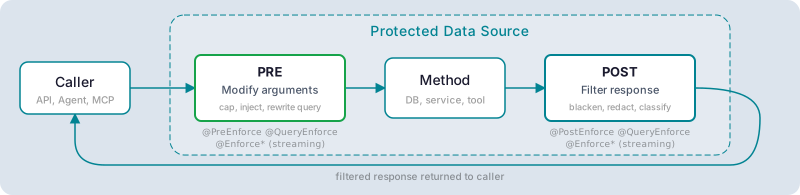
The caller can be a web request, a service method, an AI agent invoking a tool, or an MCP client calling a server tool. The PEP does not care. It intercepts the method, evaluates the policy, and applies obligations.
Pre-invocation handlers modify the method’s arguments before it executes. When the method is a database query, this means the query itself changes. The database only returns authorized rows. Unauthorized data never leaves the database, never crosses the network, and never enters the application’s memory. When the method is an AI tool call, the policy can cap parameters, inject constraints, or narrow the scope of the operation before the tool runs. This is the strongest form of data-level security.
Post-invocation handlers transform or filter the method’s return value after it executes. The method runs with its original arguments, retrieves the full result, and the PEP applies redaction, field removal, or collection filtering before returning to the caller. When an AI agent calls a patient lookup tool, the response is redacted before the LLM ever sees the data. This is simpler to implement but means the full dataset is retrieved first. For large result sets, this has performance and security implications: the data briefly exists in the application’s memory before filtering.
Both interception points use the same policy. The obligation type determines which handler runs. The annotation determines which points are available:
| Annotation | PRE (modify arguments) | POST (filter response) |
|---|---|---|
@PreEnforce |
Yes | No |
@PostEnforce |
No | Yes |
@StreamEnforce (streaming) |
No | Yes (per item) |
@PreEnforce evaluates the policy before the method runs. It can modify arguments but never sees the return value. @PostEnforce evaluates the policy after the method runs, using the return value as part of the authorization subscription. It can transform the response but cannot modify the arguments. The streaming annotation @StreamEnforce applies the post-invocation point to every item the stream emits, so redaction obligations follow each element on its way to the client. Query rewriting needs no annotation of its own. A query-rewriting obligation on a @PreEnforce decision rewrites database queries while they are in flight, as shown further below.
Pre-invocation: modifying arguments
A fund transfer endpoint accepts an amount. The policy permits the transfer but caps the amount at 5,000:
policy "permit-transfer"
permit
  action == "transfer";
  resource == "account";
obligation
  {
    "type": "capTransferAmount",
    "maxAmount": 5000
  }
The method is annotated with @PreEnforce, which tells the PEP to evaluate the policy and apply obligations before the method executes:
@PreEnforce(action = "'transfer'", resource = "'account'")
public Mono<TransferResult> doTransfer(Double amount, String recipient) {
    return Mono.just(new TransferResult(amount, recipient, "completed"));
}
@pre_enforce(action="transfer", resource="account")
def do_transfer(amount: float = 10000.0, recipient: str = "default"):
return {"transferred": amount, "recipient": recipient, "status": "completed"}@Post('transfer')
@PreEnforce({ action: 'transfer', resource: 'account' })
transfer(@Query('amount') amount: string, @Query('recipient') recipient: string) {
return { transferred: Number(amount), recipient, status: 'completed' };
}The application registers a constraint handler that the PEP calls when it encounters the capTransferAmount obligation. The handler modifies the method’s arguments before the method runs. The endpoint function never sees the original value.
@Component
class CapTransferHandler implements MethodInvocationConstraintHandlerProvider {

    @Override
    public boolean isResponsible(Value constraint) {
        return constraint instanceof ObjectValue obj
            && obj.get("type") instanceof TextValue t
            && "capTransferAmount".equals(t.value());
    }

    @Override
    public Consumer<ReflectiveMethodInvocation> getHandler(Value constraint) {
        var maxAmount = ((NumberValue) ((ObjectValue) constraint).get("maxAmount"))
            .value().doubleValue();
        return invocation -> {
            var args = invocation.getArguments();
            for (int i = 0; i < args.length; i++) {
                if (args[i] instanceof Double d && d > maxAmount) {
                    args[i] = maxAmount;
                    invocation.setArguments(args);
                    return;
                }
            }
        };
    }
}
class CapTransferHandler:
def is_responsible(self, constraint):
return isinstance(constraint, dict) \
and constraint.get("type") == "capTransferAmount"
def get_handler(self, constraint):
max_amount = constraint.get("maxAmount", 0)
def handler(context):
if "amount" in context.kwargs:
requested = float(context.kwargs["amount"])
if requested > max_amount:
context.kwargs["amount"] = max_amount
return
for i, arg in enumerate(context.args):
if isinstance(arg, (int, float)) and arg > max_amount:
context.args[i] = max_amount
return
return handler@Injectable()
@SaplConstraintHandler('methodInvocation')
export class CapTransferHandler implements MethodInvocationConstraintHandlerProvider {
isResponsible(constraint: any): boolean {
return constraint?.type === 'capTransferAmount';
}
getHandler(constraint: any): (context: MethodInvocationContext) => void {
const maxAmount = constraint.maxAmount;
return (context) => {
const requested = Number(context.args[0]);
if (requested > maxAmount) {
context.args[0] = maxAmount;
}
};
}
}The request POST /api/transfer?amount=8000 reaches the endpoint with amount = 5000. The policy capped it. The endpoint processed it. The client received the result. All three frameworks produce the same output from the same policy.
Post-invocation: built-in content filtering
For common data transformations, no custom handler is needed. SAPL ships a built-in filterJsonContent obligation that supports three actions on any JSON path:
policy "permit-patient-full"
permit
  action == "readPatientFull";
  resource == "patientFull";
obligation
  {
    "type": "filterJsonContent",
    "actions": [
      { "type": "blacken", "path": "$.ssn", "discloseRight": 4 },
      { "type": "delete", "path": "$.internal_notes" },
      { "type": "replace", "path": "$.email", "replacement": "redacted@example.com" }
    ]
  }
The endpoint returns a patient record. The PEP applies the obligation:
| Field | Original | After obligation |
|---|---|---|
ssn |
123-45-6789 |
XXXXXXXX6789 |
internal_notes |
"Patient history..." |
(deleted) |
email |
jane@hospital.org |
redacted@example.com |
No handler code. The obligation type filterJsonContent is registered by the SDK. The policy author controls what gets blackened, deleted, or replaced.
Post-invocation: filtering collections
When the endpoint returns a list, an obligation can filter elements by a policy-defined criterion. A classification filter removes documents the user should not see:
policy "permit-documents"
permit
  action == "readDocuments";
  resource == "documents";
obligation
  {
    "type": "filterByClassification",
    "maxLevel": "INTERNAL"
  }
The endpoint returns four documents:
[
  { "title": "Q3 Report",     "classification": "PUBLIC" },
  { "title": "Org Chart",     "classification": "INTERNAL" },
  { "title": "Merger Plan",   "classification": "CONFIDENTIAL" },
  { "title": "Board Minutes", "classification": "SECRET" }
]
The client receives two:
[
  { "title": "Q3 Report",  "classification": "PUBLIC" },
  { "title": "Org Chart",  "classification": "INTERNAL" }
]
The handler is a FilterPredicateConstraintHandlerProvider in Spring, a FilterPredicateConstraintHandlerProvider in Python, and the equivalent in NestJS. Each checks the element’s classification against the policy-specified maxLevel and excludes elements that exceed it. Elements without a classification are excluded (fail-closed).
AI tool calls and MCP servers
The same obligation mechanisms apply when an AI agent calls a tool or an MCP client calls a server tool. The PEP intercepts the tool invocation, evaluates the policy, and applies obligations. The AI agent or LLM never sees unauthorized data.
Pre-invocation: a policy caps the number of results an AI agent can request from a search tool. The limitResults handler modifies the limit parameter before the tool executes. The LLM asked for 1000 results. The tool received 50. The agent does not know the limit was applied.
Post-invocation: a policy redacts PII from patient records before they reach the LLM. The tool returns the full record. The PEP blackens the SSN and removes the address. The LLM generates its response from the redacted data. The original data never enters the model’s context window.
This is the same filterJsonContent obligation, the same MethodInvocationConstraintHandlerProvider, and the same MappingConstraintHandlerProvider shown above. The FastMCP demo implements all of these handlers for MCP tool calls. See the AI Tool Authorization and MCP Server Authorization guides for the full AI-specific walkthrough.
Pre-invocation at the database: query rewriting
When the method being protected is a database query, argument transformation becomes row-level security. The database only returns rows the user is authorized to see. No post-query filtering. No data leakage through pagination.
Query rewriting needs no dedicated annotation. You annotate the calling service method with @PreEnforce as usual, and the policy attaches a query-rewriting obligation. While that decision is being enforced, every query the method issues is intercepted, the obligation is merged into it, and the rewritten query is what reaches the driver. In Spring, the Boot starter activates this transparently when it sees R2dbcRepository or ReactiveMongoTemplate on the classpath. It wraps DatabaseClient for R2DBC and ReactiveMongoTemplate for MongoDB, so derived queries, @Query methods, and direct databaseClient.sql(...) calls all run through the wrapped bean. No repository annotations are needed.
@Service
public class BookService {

    @PreEnforce(action = "'findAll'")
    public Flux<Book> findAll() {
        return bookRepository.findAll();
    }
}
Three rules hold for every backend and SDK. The obligation can only narrow the user’s query, never widen it, because it is AND-combined with whatever the user already requested. A malformed or unsupported obligation denies the decision, fail closed. And the integration must be registered before its obligations take effect, because a decision carrying a query-rewriting obligation with no matching integration is denied rather than silently unfiltered.
SQL
The sql:queryRewriting obligation carries typed criteria that become WHERE predicates:
set "book listing"
first or abstain errors propagate
for action == "findAll"

policy "deny if scope null or empty"
deny
    subject.principal.dataScope in [null, undefined, []];

policy "enforce filtering"
permit
obligation {
    "type": "sql:queryRewriting",
    "criteria": [{
        "column": "category",
        "op": "in",
        "value": subject.principal.dataScope
    }]
}
A user with dataScope: [1, 2, 3] turns the original SELECT * FROM books into SELECT * FROM books WHERE category IN (1, 2, 3). The policy author writes the criteria, the SDK applies them, and the application code never sees the difference.
| Field | Purpose | Example |
|---|---|---|
criteria |
Typed conditions, AND-joined, groupable with and/or |
{"column": "status", "op": "=", "value": "active"} |
conditions |
Raw SQL fragments for what the typed language cannot express | ["created_at > CURRENT_TIMESTAMP - INTERVAL '7 days'"] |
columns |
SELECT projection narrowing, intersected with the query’s own projection | ["id", "name"] |
MongoDB
The mongo:queryRewriting obligation mirrors the SQL form without the columns projection:
policy "enforce filtering"
permit
obligation {
    "type": "mongo:queryRewriting",
    "criteria": [{
        "column": "category",
        "op": "in",
        "value": subject.principal.dataScope
    }]
}
Typed criteria accept the same operators as SQL except like and notLike. For pattern matching, the conditions escape hatch carries raw query fragments with $regex, each merged into the query inside a top-level $and. Fragments must be strict JSON with double quotes, and a fragment that fails to parse denies the decision.
Because the obligation format is identical across SDKs, the same policy produces the same narrowing everywhere that backend appears: sql:queryRewriting works on the Spring R2DBC integration and the Python SQLAlchemy integration, and mongo:queryRewriting works on Spring, the Python sapl_pymongo integration, the NestJS Mongoose integration, and the PHP Doctrine ODM integration.
One caution applies in every stack. Database access that bypasses the wrapped bean or session, such as a raw connection or an unwrapped second client, is not intercepted and runs unfiltered. Keep enforced reads on the integrated path, or you own row-level security manually for the paths outside it.
For JPA (blocking), the same result is achieved using @PreEnforce with a custom MethodInvocationConstraintHandlerProvider that modifies the method’s filter parameter before execution (as shown in the argument modification section above). See Query Rewriting for the full obligation reference and the per-integration coverage notes.
Seven handler types
The examples above show three of the seven constraint handler types available in every SDK:
| Type | Phase | What it does | Example |
|---|---|---|---|
| MethodInvocation | Pre-invocation | Modifies arguments before method runs | Cap transfer amount, rewrite query |
| Mapping | Post-invocation | Transforms return value | Redact fields, reshape response |
| FilterPredicate | Post-invocation | Filters collection elements | Classification filter |
| Runnable | On decision | Side effect (no data access) | Log access |
| Consumer | Post-invocation | Observes return value (read-only) | Audit trail |
| ErrorHandler | On error | Observes exception | Notify on error |
| ErrorMapping | On error | Transforms exception | Add support URL |
All seven are available in Spring, Python (Flask, FastAPI, Django, Tornado), NestJS, and .NET. The filterJsonContent built-in handles the most common case (blacken, delete, replace on JSON paths) without any custom handler code.
Related
- SDK Integrations: handler registration and lifecycle for each framework
- Streaming Authorization: obligations that change mid-stream as conditions change
- Multi-Framework Authorization: the same 28 endpoints across 7 frameworks
- spring-demo: all handler implementations in Java
- Python demos: the same handlers in Flask, FastAPI, Django, Tornado
- NestJS demo: the same handlers in TypeScript